That afternoon in May
At 14:28 on May 12, 2008, a magnitude 8.0 earthquake struck Wenchuan in Sichuan (the USGS measured 7.9). Xinhua placed the epicentre at Yingxiu, a town in Wenchuan County. A Xinhua report in June called it the most powerful earthquake in China since 1949.
Classes were in session when it hit, and many pupils were buried when their school buildings collapsed. Beichuan, Yingxiu, Dujiangyan, Mianzhu and Qingchuan suffered the heaviest losses, and roads and phone lines in the mountains were cut over a wide area.
The death toll rose day by day in the first weeks. On May 13 reports put the dead in Sichuan at 8,533; the national toll was 22,069 on May 16, 28,881 on the afternoon of May 17 and more than 51,000 by May 22. On May 24 Wen Jiabao said it could finally reach 70,000 or 80,000 or more. An estimated 5 million people had lost their homes.
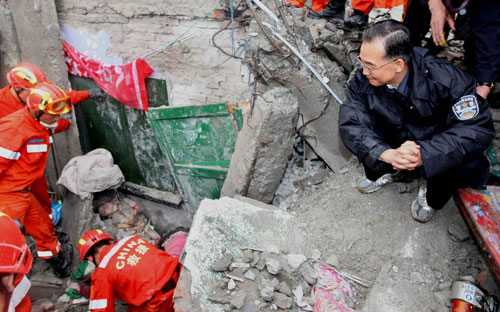
More than 130,000 soldiers and armed police went into the quake zone, and rescue teams came from Japan, Russia, South Korea and Singapore. Volunteers from all over China drove into the mountains, and companies, ordinary people and overseas Chinese gave money. Survivors pulled out after more than 100 hours, a boy holding up a drip bottle, and a pig that lived 36 days under the rubble became stories the whole country followed that spring and summer.
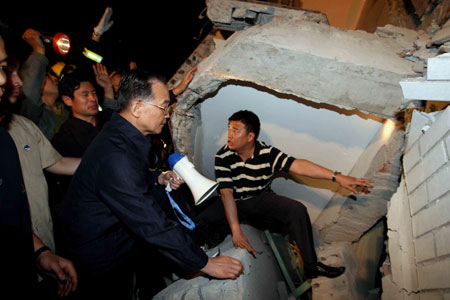
This special uses 2008 news reports to follow the rescue, the survivors pulled from the rubble, the leaders' trips to the disaster zone, the volunteers and donations, the row over the schools, the national mourning, the aftershocks and quake lakes, the pandas of Wolong, the rebuilding, and the quake zone at the Beijing Olympics.
The official figures of September 25
The figures come from a China News Service report of September 25. The State Council Information Office released them on behalf of the State Council's quake relief headquarters, as of 12:00 that day.